
Packing Supplies Checklist: What to Gather Before You Pack
On this page
Packing supplies to gather before you box anything
A shopping and borrowing list, grouped by what the supply does. Counts depend on your home, so this list has none.
0 of 25 done
Containers
Heavy things in a big box make a box nobody can lift.
Cushioning and protection
Closing and labeling
Tools and moving aids
Do not box these for the truck
Ask your mover for its own list of items it will not carry; each company's list differs.
The booklet in Appendix A to Part 375 says federal law forbids shipping hazardous materials in household goods boxes or luggage without informing your mover.
Source: eCFR, 49 CFR Part 375
Part 375 also lists perishable articles alongside dangerous and hazardous ones as items a mover need not assume liability for if included without its knowledge (375.203).
Source: eCFR, 49 CFR Part 375
Sources (1)
- eCFR, 49 CFR Part 375 ecfr.gov
In short: Gather containers, padding, tape and labels, and tools before you start, and keep hazardous materials and perishables out of the boxes. Counts depend on your home, so use a calculator or a quick room-by-room estimate.
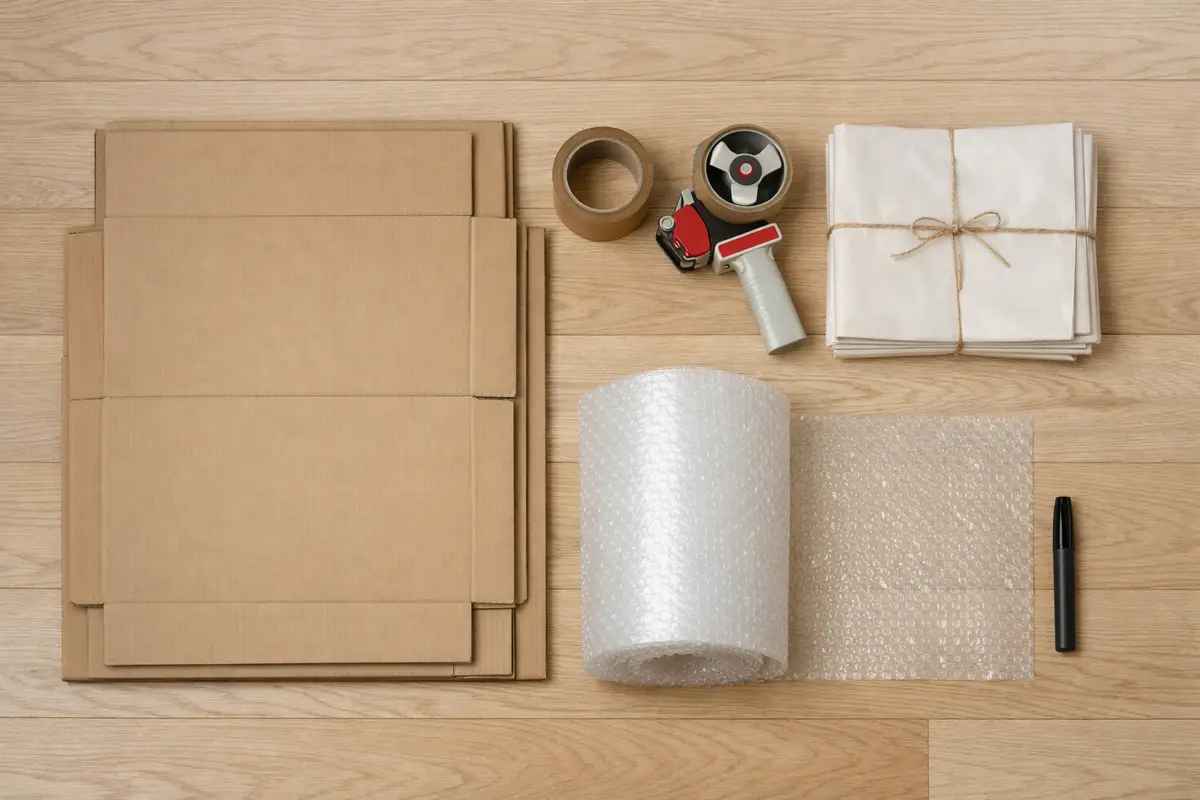
Packing goes faster, and costs less in re-buying, when everything is in the hallway before the first box is taped. This checklist is for people packing their own home, whether you hire movers to carry or not. It groups supplies by what they do, so you can buy or borrow each type in one trip.
How to use it
Tick the types you have already, then shop for what is left. The list has no quantities, because the numbers depend on your home and how you pack, and a guess from a stranger would be worse than none. For a box count, the Calcimator packing supply calculator does the arithmetic from your home's size. As a plain check, after you pack the first room, you will know how many boxes a whole room takes, and you can multiply.
Start with the containers, since they decide everything else. Choose small boxes for dense things like books and tools, because a heavy big box is a risk to your back and the crew's. Choose bigger boxes for light and bulky things like bedding.
Why the sections are in this order
Containers first, then cushioning, then closing and labeling, then tools. That is also the order you will use them: boxes, padding inside, tape and label on the outside, and tools for furniture. The last section is not about buying. It lists what to keep off the truck.
Worked example: a one-bedroom apartment
Suppose you are moving from a one-bedroom apartment. You start with the containers section and take stock of what you can borrow: a few totes, a laundry basket. You will need small boxes for books and the pantry, medium for the kitchen, and one large for bedding. The wardrobe boxes may not be worth it, as the closet clothes can go in a bag on hangers.
For cushioning, you use towels and sheets, and buy packing paper and a roll of bubble wrap for glasses and the television. In the labeling section, you decide on a color per room, and a marker and a roll of tape for each room you will pack in parallel. In tools, you borrow a dolly from a friend. You write what you need, shop once and stop.
What changes the list
More fragile items means more packing paper and dish boxes. Furniture that comes apart means a screwdriver set and zip bags. Stairs and long carries make a dolly and straps worth having. Hiring professional packers changes it entirely, as they bring their own materials, and you should ask what is included in the estimate.
What not to pack
Ask your mover for its list of items it will not carry. In the meantime, the booklet that Part 375 reproduces says federal law forbids shipping hazardous materials in household goods boxes or luggage without informing your mover, and Part 375 says a mover need not assume liability for perishable, dangerous or hazardous articles included without its knowledge. Fuel, paint, cleaning chemicals and propane are the usual household examples, but your mover's own list is the one to follow. Keep perishable food, documents and medication out as well.
Related: the printable moving checklist includes this by room, and the moving day checklist covers the crew.
Questions people ask
Should I buy or find free boxes?
Either works. A free box is fine if it is clean, dry and still holds its shape when you press on a corner. Skip any that sag or smell of damp.
Do I need special boxes for dishes?
Not necessarily. Paper around each piece and a small box packed firmly can do the job. Dish boxes with dividers help if you own a lot of glass.
Sources
- eCFR, 49 CFR Part 375 ecfr.gov